Hi friends~
I started writing this newsletter five years ago as a personal challenge: to build a new habit and hone a skill people have occasionally told me I was pretty good at. So the weekly Thoughtbox was born on my coaching website, then it made its way its way over to Substack too. It is never an easy task – sometimes it’s really hard – but worth it for the mental exercise, and so rewarding to read your comments!
It’s a mix of ideas, science, practical information, and musings, all meant to be useful, engaging, and thought-provoking.
If you find value in these weekly reads, I’d be honored to have you subscribe to both Thoughtbox and Substack (if you think it’s worth it, there is a paid subscription), and if you follow along with me each Monday afternoon.
Habits…the good and not-so-good.
I have some good habits, like regular exercise, and it’s no surprise where that will get me as I stick with it throughout my life. But I have a bad habit too.
I started picking my cuticles at around the age of 11, and I remember exactly the friend who told me that she liked doing it. I had just started my period, and with so many hormonal changes, it was instant stress relief. Honestly that girl was sharing her bad habit, and it was like sharing a drug. I became addicted.
To keep my hands occupied my mom tried to get me to learn to knit (she also told me to sit on my hands which did not work). I liked crochet, cross stitch, and needlepoint, and it all worked for a while but it didn’t stick. It was just easier to pick, because fingers are always readily available. I know. Gross. That’s where it has gotten me…picked fingers.
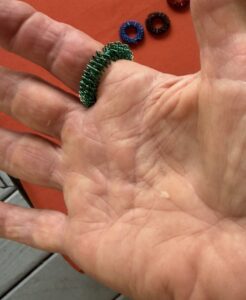
Changing this habit might finally be on the horizon because I just learned about fidget rings – spiky, small sensory rings that provide the weirdly similar stress relief feeling of picking, and repetitive finger movements, without the damage to skin. I bought a few packs of them and I’ll let you know how it goes. Breaking the picking habit will get me to a pretty manicure.
Why that habit stuck.
- Calming Stress, aiding thinking: It quiets down distracted thoughts, helps focus, improves attention.
- Boredom Fix: My hands look for something to do while watching TV, at a movie, in a class, or in a meeting, and picking helps me stay attentive.
- Brain Reward: The brain gives me a tiny hit of feel-good chemicals when I “fix” a rough spot, and that brief satisfaction makes me keep doing it – often making the skin worse. Rolling the sensory ring around on my fingers will hopefully provide that satisfaction, and lead to nice looking nails.
Humans are creatures of habit.
The science: Habits are in our evolutionary wiring. Routines conserve mental energy by allowing the brain’s basal ganglia (a group of structures deep inside the brain that help control voluntary movement, learning, and emotions) to shift repetitive tasks onto autopilot. This frees up your prefrontal cortex for higher-level thinking, explaining why we naturally seek the comfort of predictable patterns. (My cuticle picking for example.)
Shifting a stubborn habit takes strategy.
- The Habit Loop: According to behavioral science, every habit has three parts: a cue (trigger), a routine (the action), and a reward. You cannot simply delete an old behavior, but you can swap out the routine using the same cue and reward to rewire your pathways. Here’s deep dive: Creatures of Habit: The Neuroscience of Habit and Purposeful Behavior
- Start Micro: Massive overhauls can trigger major resistance. But tiny new habits can be almost effortless, and it can really help to tradeoff one bad habit for a new good one.I f you really do want to start a strength training routine “habit”, you can start by signing up with a coach (me!), which will keep you on track, because you’ll be accountable.
- Break Your Environment: Familiar contexts trigger automatic behaviors. Changing the physical environment, which I’ve mentioned before – like doing a stretch, or taking a quick walk when I’m feeling task paralysis.
Habits provide security – the familiar is comforting, even if it’s a habit you do want to break – the work of ditching any not-so-good habit sparks adaptability, especially if you’re substituting a new one – that’s personal growth, and it works no matter how old you are or how ingrained the habit.
It takes an average of 66 days to change, or adopt a new habit.
What habit are you looking to break, or what habit would you build?
I’m game. How about you?
x
Polli