
As a coach working in the fitness/strength business, it seems like lately there are more and more questions than answers. It feels like the goalposts aren’t just moving – the games are being played on different fields by constantly opposing teams. Maybe that’s the ploy – keep us confused so we keep buying more.
These are questions I’ve been thinking about in my practice, and I’m really curious to know whether you have answers – or more questions?
Q: Is muscle the new unattainable beauty standard?
A: For a while it felt like a victory when the culture and the focus on women’s workouts shifted toward building strength. The message was that strong women were being celebrated in every shape and size. But the industry and media has commodified it. Women are now barraged with videos and images implying that they need to be strong, look muscular, without adding any “bulk.” What does “strong is the new skinny” really mean? Strength doesn’t have a “look”, but the cultural goalpost has shifted from the shrinking body, and toxic media is pushing the perfect chiseled physique.
It’s the same body policing, just wrapped in a sports bra.
If strength training requires lifting a heavy loaded barbell at a gym – are women with full-time jobs, kids, or limited resources doomed to keep scrolling toxic fitness content and feeling like they’re failing? We can resist being brainwashed by the skewed baseline of what a strong “athletic” body looks like.
Q: How is skinny trending at the same time as strength?
A: This is the problem with the current scenario. It’s a bizarre moment where the “feminine” (extreme, rail thin) look is making a massive, pharmaceutical-backed comeback. Women are being bombarded with two completely opposing messages simultaneously: Build muscle for your longevity and quality of life, but shrink your body to appeal to the beauty standard. This relentless dichotomy is exhausting. It’s driving women to two extremes – either obsessively chasing both impossible standards at once, or giving up entirely because the math simply doesn’t add up.
Serena is the perfect spokesperson. I don’t dismiss that she seems to be successful in achieving the thin + strong standard, including performance – but she is Serena after all, with unlimited resources. Serena’s comeback.
This is a tough one. GLP1s are being marketed now as the remedy for everything, and some of the hype is supported by studies. The drug can create a massive calorie deficit, leading to fat loss and unintentional muscle loss, and users should know going in that it’s typically long-term or indefinite therapy.
If you’re 40 wearing a size 2-4 dress, but when you’re 65 and have osteoporosis, you’ve been tricked.
Q: Are activity trackers helping or policing?
A: Body intuition has been outsourced to wearable tech. I don’t use a tracker or any apps. Do you? When I was training on my bike I evaluated every data point. For years I used the fitness app on my Apple watch, but my tendency to obsess about numbers was getting in the way of simply enjoying movement and workouts. I was checking my heart rate and power zones, and loooking at my watch instead of focusing on the most important thing: rate of perceived exertion RPE – how I feel during each rep, a set, or a workout, bike ride, run, or row. An algorithm just isn’t empowerment for me – it’s hyper-vigilance. That goes for sleep tracking too. It doesn’t add to the quality of my day to know that I slept poorly the previous night.
How about you?
Q: If strength training is the most important thing, does it matter how we do it?
A: Progressive overload builds bone density and muscle mass. Strength training is the ultimate anti-aging tool. It preserves muscle and bone density, boosts metabolism, and lowers the risk of chronic diseases like heart disease, diabetes, and dementia. Working out with a certified, experienced coach or trainer is the best way to achieve strength and mobility, keeps us accountable, and it can happen with a few sets of free-weights virtually, with videos, or in-person.
High intensity workouts are excellent as a part of a strength and fitness training program. High-volume HIIT group fitness classes have been popular for years – they’re a great money-maker for gyms, promising weight loss, sculpting, “toning”, and strength. But is swinging tiny weights for hundreds of reps, zooming from station to station in circuits, sweating profusely really strength training? Cardio disguised as lifting will keep women stuck in the shrinking cycle.

Q: Is “toning”real?
A: I’m rolling my eyes. But to be fair: “toning” is a word used by women who have been fed fitness magazine marketing their entire lives. This is the persistent vocabulary we’ve been given to describe muscle definition, and the aesthetic of a body that adheres to a standard.
The mandate of a good coach isn’t to police language – it’s to give clients tools they can use to build strength, mobility, and to feel good in their bodies. So call muscle definition “cut”, “toned”, ripped” whatever. It’s still scientifically “hypertrophy” (muscle growth), and while it does look good, when strength happens at the same time, it’s great!
Q: Should fitness professionals rely on their bodies as their resume?
A: This is a tough one. A great looking fitness influencer might get a whole lot of likes and sell programs – and the buyer might not know much about the coach’s cred other than appearance. There are excellent, successful coaches with very different and non-standard body types, and at all ages. Who would you hire?
As a fitness professional – does posting images and videos sell work as a sales pitch, or is it an annoying signal of a higher level of virtue – and a total turnoff? Legit coaching should be centered on the client, on health, and true wellness, not the coach’s physical appearance.
This is a fitness influencer with a non-conventional appearance and a GREAT message: Christine Hobson
Where I stand on all of this…
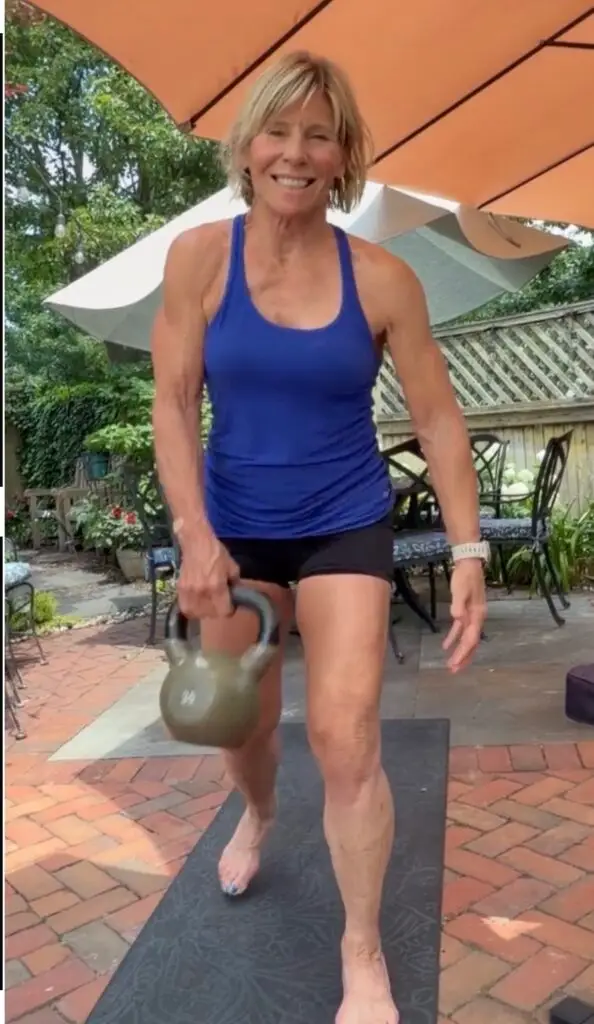
Just like most women, my body has gone through changes over a lifetime of 73 years. Weight gain and loss – 30 pounds up and down in college, and six babies. I started strength training in my late 40s and early 50s. Now I navigate the realities of post-menopause, and hormone shifts.
Because I usually post happy, energetic, strong-looking images and videos of my workouts, people might assume this is “easy” for me, or that I’ve been doing it my whole life. I was not an athlete growing up, so starting as an older adult has never been easy. I’ve learned to accept that doing hard things can be fun (even though one of my clients says my definition of fun is “sick”) it’s super rewarding, and the result is a stronger me.
So strength isn’t about maintaining a static, frozen-in-time aesthetic. It’s about building a resilient mind, and a body that can withstand change. True wellness isn’t found on a digital dashboard, a scale, a device measuring your heart rate in a group class, or an idealized social media grid. It’s found in the quiet, hard, and very rewarding work of building a body and brain that can show up for your life. And there are lots of ways to do it.
Is it really fun? Well, yes, it is a type of fun – hard, but so worth it, and it feels so great when you’re done!
Last thought:
You can start – or start again at any time, at any age. You don’t stop moving because you get old, you get old because you stop moving. Strength isn’t just about exercise. It’s about handling the unpredictability of life with confidence and capability.
Over to you: tell me what you think!
X Polli